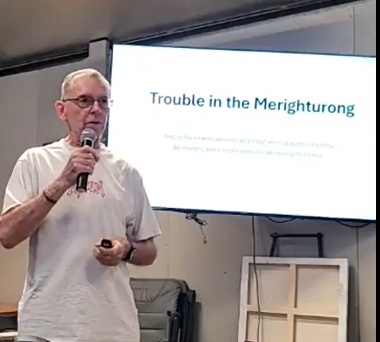

Trouble in the Merighturong

This is a 24 minute case study presentation about a hypothetical organisation adopting a fatally flawed policy that caused it to implode. It bears no resemblance to any real person or organisation. The scenario is so ridiculous that it enables fun to be poked at the egotistical “Me right, you wrong” positions adopted. It hopefully facilitates considering how our own egos or experience or self-assured confidence or righteousness can draw us into premature conclusions and judgements that self-sabotage our otherwise good intentions. All the suggested learnings come from my own unfortunate and regrettable mistakes, embarrassements and subsequent reflection over many years. While laughing at the stupidity of the example, I suggest approaching it with the intention of identifying “How I might have accidentally generated whatever communication predicament I currently find myself in?” If we reject the coercive control paradigm, then we can’t change other people and can only change ourselves – even though we can all put up enormous resistance to doing so, often without realising it. 

To appreciate the full intent and meaning, I recommend watching the full presentation first rather than jumping to the transcript. You’ll also hopefully enjoy it more that way. Click on the image below to see it. 

Transcript

This is for entertainment and educational purposes only. All names and circumstances are purely fictional.

The Situation: The Merighturong Community Group (MCG) is situated in a local area of the country which takes its name from mythical dreamtime.  The group’s stated values are peace, love and tolerance. Its founding members had much enthusiasm. Some had corporate employment experience they were eager to apply for community benefit. All went well until one issue came up that not everyone agreed with. The group then started having trouble getting anything done due to the strength of conviction of several members who objected to the views and subsequently the behaviours of the other group members. The office-bearers strongly opposed the views being presented and were frustrated with this issue impeding group progress.

The Solution: Get the group to adopt of a policy preventing such disruption.

no dickhe@ds policy

The Supporting Case: Arguments presented by the management committee in support of this policy included:

  1. It is quite self-evidently sensible and desirable.
  2. It is non-discriminatory on any religious, racial, gender, disability or cultural basis.
  3. It is eminently compatible with control via any AI system that might become available ( allowing despatch of such individuals to some suitable social Gulag).
  4. It is so obvious what a dickhe@d is that no definition of it is required.
  5. Determinations of who is being a dickhe@d will be made by the committee, so don’t you worry about that!

The Vote:

The motion was put, the trouble-makers were shouted down, the democratic majority process was applied and it was overwhelmingly passed.

The Outcome: Reality and unintended consequences soon set in.

The dissenters stormed out, resigned from the group and set up their own Deplorable Dickhe@ds group to harass and undermine the MCG.

Legal challenges ensued and money was poured into consequent fundraisers for both sides to pay appreciative and expensive legal professionals to fight it out for them.

Ill-feeling and discord spread throughout the community and the stated values that had prompted the initial formation of the group flew out the window and became completely unattainable.

Hamartia had prevailed i.e. despite the heroes most earnest and valiant efforts, they achieved exactly the opposite of what they set out to do.

The Policy problem:

It was fundamentally flawed. To recognise that, all we needed to do was think back to circumstances in our own lives when we acted like a complete dickhe@d and were blissfully unaware of doing so.

The first and most obvious issue is that virtually no one realises they are being a dickhe@d at the time, so it is impossible to give notice!

Secondly, the above policy would eventually condemn everyone, as it overrides learning from mistakes. As the old saying goes “A man who never made a mistake never made anything”.

Thirdly, it didn’t define what a dickhe@d actually is.

Definitions:

So, if we are serious, we have to define what a dickhe@d is. I define it as:

someone who doesn’t perceive something that others do (or makes a mistake, or misses the mark).

(That last one is also the religious definition of sin. But mistakes are how we learn. So we must make lots of them to achieve enlightenment, i.e. sin a lot. So that must justify the Sabbatian Frankist religious dogma of sinning your way to heaven!? But they interpret mistakes to mean deliberately doing diabolical things. That takes the definition of ‘mistake’ to a ridiculous extreme. Many of my blog posts deal with those diabolical things. But we’re here to have some fun with not taking ourselves too seriously today, so will ignore those things here.)

It will also be useful to define the related term of bullsh@t. Although this term is similarly politically incorrect, it is most useful, as it enables lies to be called out without accusing the teller of lying. They may just be a dickhe@d if they are unaware of the falsity of what they are saying! I define bullsh@t as:

untruth that is either undetected by the speaker or intended to mislead the listener.

Avoiding this outcome in our group:

We need a way of detecting when we might be unknowingly acting like dickhe@ds ourselves and talking bullsh@t.

While I have had no formal training in how to avoid being a merighturong (dickhe@d) to base my conclusions upon, I have unfortunately had extensive field experience. But rather than re-traumatising myself by entertaining you with excruciating examples, I’ll distil some observations from these personal humiliations.

These are my ten suggestions (Beseechments?/ Commandments?) of merighturongery (dickhe@dry):

They just require asking ourselves some questions:

  1. What does my new adversary (source of personal growth to whom I should be grateful) think I said?
    • It doesn’t matter what I think I said; it’s what whoever heard what I said thinks I said that really matters. That’s what will determine how they react.
  2. Have I considered and accounted for my audience’s context/ circumstances/ background?
    • Simple, accidental, unintended offence or insult can so easily come from failing to do this. Whichever side of that you happen to find yourself on, perhaps consider that before labelling your newly found offender as anything – including being overly sensitive or easily offended or domineering or destructive or subversive.
  3. How many times do I use the words I or me? Count them.
    • How much of this is self-absorption? How interested will other people really be in me/ what I’m doing or feeling? They’ll be much more interested in themselves (Just like me perhaps?).
    • Am I presenting something (that I think is) for their benefit, that is really only for mine?
    • Am I just processing some hurt or trauma or learning to understand something myself?
    • Am I really meant to be teaching the world?
    • Is it really a new experience for the world or is it only a new experience for me in my own little world?
    • Do I really want that level of personal disclosure/ display?
    • Has the motivation to teach only come from within?
    • Have others independently, without prompting, suggested I do it?
    • (Self-evaluation is often aspirational and self-praise is rather faint!)
  4. How many times do I use the words they or you? Count them.
    • Am I accusing whoever ‘you’ is?
    • Are ‘they’ the problem? i.e. Might it just be possible that something I’ve accidentally personally done or presumed might have justifiably generated that reaction that I don’t like from them?
    • Might I be better taking the initiative to do something about it myself?
  5. How passionate and insistent am I on the subject?
    • Do I stop to draw breath, allowing the other person to speak, or even think?
    • Might that seem domineering and/ or difficult to them?
  6. How do I handle dissent from my own views?
    • Personally, as well as in public?
    • Can I tolerate other people’s disagreement with good grace?
    • What do I do when I sense audience resistance? Are they really dense? Or might I be blaming them for my dogmatism or communication deficiency?
  7. How dogmatically do I hold to beliefs I have adopted, when others challenge them, or worse still, produce evidence demonstrating they are false?
    • (I have particularly observed military people struggling with this one. Once a belief is associated with mission, their training kicks in. A mission, once set, has to be achieved regardless of anything else. All opposition has to be eliminated regardless. There can be no deviation from the objective. Lives (on your side) depend upon it. Any alternative reasoning must be regarded as subversion by spies and strenuously ignored, no matter how compelling the logic.
    • I have also observed religious people struggling with somewhat similar difficulties, with particular dogma in place of mission.)
  8. Does this particular circumstance call upon me to assert or to consider?
    • That depends upon whether it’s a personal growth situation or not.
      • If I’m being gaslit, deceived or exploited, I need assertive confidence in my own views to pushback immediately. It’s ineffective to be treating someone trying to kill, harm or defraud me with peace, love and brotherhood. The time for that, along with other reflection, may come after the threat has been dealt with. But I will generate no respect and have no ability to lead if I’m indecisive now.
      • However, if there’s no real physical, moral or psychological danger, then it’s only a fake threat to my ego and is a personal growth situation. I need to sit back, cop it sweet, be gracious, accept, reflect and learn – regardless of my age, expertise or experience.
  1. How do I handle my knowledge or experience being challenged or found to be insufficient or not generic?
    • Many statements can be true within their context but false in circumstances outside it.
    • Recognising this enables us to find the truth in statements that are generically false. This commonly occurs when others generalise what is true for them, into belief that it is universally true for the rest of the world.
    • Truth is relative to context but absolute within it. If we want to speak truth that is truly generic or ‘right’, we need to fully investigate and specify its context.
  2. How can I be right more often = how can I avoid hanging myself out to dry on my ego? = how can I not be a dickhe@d?
    • by attaching my self-esteem and ego to the process of discovering truth, rather than to the content of my framework/ dogma/ judgements/ habits or conclusions drawn along the way, determined in my own little world, all seeming like good ideas at the time.

Conclusion

There are many ways of accidentally sabotaging ourselves and producing dysfunction, quite apart from being formally recruited or tricked into being ‘controlled opposition’.

To reiterate, in any communication, consider first the other person’s context. Success in communication depends upon not upon what I said, but on what the other person thinks I said. Sometimes when we get resistance, we need to ask to get confirmation of what that was.

It’s up to me to put things in a way others can relate to. It’s a mistake to be regarding that as ‘sucking up’ to people. It’s just good communication.

Another question well worth considering is whether the corporate thinking or techniques or approaches I am applying are fully appropriate in the self-governing group context. Such groups will, at many times, require a different balance between the need for direction and control (to achieve progress i.e. efficiency) and the potential inefficiency of creativity and brainstorming (effectiveness – which can be much slower initially, but can equally be faster in the long run).

Perhaps we could implement our own personal DPP – Dickhe@dedness Prevention Program – which would probably be much better labelled as EAP – Embarrassment Avoidance Program.

Let’s make fun of our mistakes by making fixing them fun!

This presentation can be found on my website homepage https://governancewithoutcoercion.net .

Poster source:
https://www.facebook.com/photo/?fbid=1326887976145945&set=a.545845547583529&__cft__[0]=AZYAMrFZHQhzouVbvU0utxRM1OssgKdxsFBtq_ET0zsWdQbvNOJ_eQvva_Tv_IzkMKkkKES3SNcSWK0V8aT3MBbyoTFsirhDixocnYoDO8KUa4bIlSObXa_YdhWm9nxA4vpwhOcsb_IsgLd5E0HevpN4ylOaAiwLTGd-C0SsMsL1KS7Qp0E8Eru_d9T5mqZgZGc4Uy8xSU9U8bWJMZvQL-O&__tn__=EH-y-R

Transcript text as pdf available at https://governancewithoutcoercion.net/wp-content/uploads/2026/04/Trouble-in-theMerighturong.pdf